Monday, June 22, 2015

The Writing Thief

I purchased The Writing Thief by Ruth Culham with my students' very last Scholastic Book Clubs order last year.  I ordered it with some Bonus Points and then put it out of my mind.  I got the book literally two days before school ended.  To be honest, I had never hear of it, but I'm always looking for some interesting things to read as I spend a couple of days on planes in the summer.  (Traveling anywhere from Alaska is no joke!)


Then one day, I was checking in on Facebook.  I wandered over to this group that I'm a part of, First Grade Teacher Gab Group.  One of the threads was about summer reading plans.  Okay.  What is everyone else reading?  Maybe something that I should be reading...  Then, there is was!  A book that I randomly purchased for absolutely no reason... Someone was spouting off nothing but positive comments.  Now I'm intrigued... Not enough to pull the book off my shelf, though.  After all, I've got homework and stuff to do.  And my apartment is an absolute mess!  It still is.  I'll clean tomorrow.

Anyway.  I decided tonight to take the book out.  I read the first part of it.  I'm honestly surprised I made it through that much.  It's already past 12:30am.  I should be falling asleep right now!  But, no.  Instead, I found myself thinking the same thing I think every time I read a book like this...

Surely this doesn't pertain to me.  No.  I know it has nothing to do with me.  I mean, when you show kids' work like Joey's here, all I can think is that first graders aren't capable of that stuff!  I mean, my fourth graders could have done it, but I don't teach fourth grade anymore.

By the way, here's Joey's work that was shared:

Pretty good, huh?

Yeah.  My first graders aren't doing that.

But then I thought about Ruth's account of her time in her grandmother's bathroom... She became a reader and writer right there... and she said she was only like 4 years old!  (You'll have to read the Prologue for that story.  It's a pretty good one.)  If she could do it on her own at 4 years old, surely I can coach a bunch of 5- and 6-year-olds to want to write!

I'm in!!

In the Foreword, Kate Messner talks about how her own love of reading helped to foster her motivation to write.  She goes on to say "And as teachers, we must recognize that our very best resources for writing instruction aren't found in test prep programs or worksheets; they're in the books that we love as readers..."  I have to admit, I wholeheartedly agree!  Test makers and workbook writers are just that... test makers and workbook writers.  They are not authors.  Children need to experience a "conversation" with an author.  They need to feel comfortable questioning the author and figuring out why he chose to write what he wrote.  This is how we encourage children to become better writers; we give them authors to steal from!  (Side note: I also own the book Questioning the Author by Isabel Beck.  It's also on my reading list.)

In the Prologue, Ruth explains the situations that fostered her reading and writing independence.  She also speaks on the idea that this relationship between reading and writing is crucial to making growth in both areas.  Ruth explains how she reads texts over and over and over again, finding new meaning in each layer that she unfolds.  "This is close reading - where reading and writing intersect."  Isn't that what we want for our students to experience?  That relationship that leads to blossoming in both reading and writing?  It's what I want for my students!

I spent the last I don't know how long Google searching for blog posts, linky parties, anything about this book.  So far, I've only come up with one:  Teach Mentor Texts blogged about The Writing Thief last year.  LAST YEAR!! How have I not heard about this book then??? 

I haven't read any farther in this book yet.  I plan to.  In looking at the Table of Contents, it looks like the remainder of the book is set up to cover the educational shifts in writing instruction, some information on using and finding mentor texts, and then examples of mentor texts that can be used for each type of writing.  I still find myself holding that negativity in the back of my mind:  This book probably isn't for me.  It's surely got to be written for older grades.  After all, how can I teach my first graders to actually use the texts they are trying so desperately to decode?!  But I'm going to try to keep the negativity grounded.  Positive thinking!  Positive thinking!  Positive thinking!  I really hope this book doesn't turn out to be a giant waste of time.

If you're reading The Writing Thief, let me know!  I'd love to hear your thoughts!

EDIT:  I just stalked Teach Mentor Texts a little more, and I learned that she hosts an "It's Monday! What are you reading?" link up.  Well, this is what I'm reading... Go join up!  (There are a few links already posted, and the ones I've already checked out have some pretty good book ideas for the classroom!)

UPDATE:  I did finish the book.  You can read about it [here].


Sunday, June 21, 2015

Conferring Notebook for Reading and Writing

Okay, so I found a little motivation tonight...  I gave the whole Conferring Notebook a facelift!

The first one is the old notebook (which is still available in my TPT Store for only $3 for a limited time... the price will go up by the end of this week).  The second one is the new notebook.  I forgot how much work it was to create the notebook!  I had to start from scratch with the new one because the first one was made on a computer that I no longer have and couldn't recover any of my files.  But it's finished now!  Whew!!

I have to admit that I'm still sort of in love with Option 1, the green one.  Not because I like the notebook any better, but the colors that I used just sort of speak to me. Haha!

On the other hand, Option 2 with the kids makes me happy for all different reasons.  I like that it's school-themed, I like that it's simple, and I like that I can have it and it doesn't matter what color my room is!  I also like the cute font on that one!  ;)

Anyway.  I need someone to go through the update (Option 2) with a fine-toothed comb.  It's late, and I just finished it.  I want to put it in my TPT Store, but I need to make sure that everything is there and everything is spelled correctly.

If you'd like to volunteer, I need three people to commit to the following:
  • provide constructive feedback (you won't hurt my feelings if you tell me it's terrible - honest!),
  • tell me what else you would like to see in it (what would help you more),
  • make sure that what I said would be there is actually there,
  • check my spelling, and
  • make sure my explanation of the contents is sensible.
If you can do all of that before Tuesday, June 23, please let me know.  I will take the first three people that make the commitment.  Please make sure to leave me your email address!

UPDATE:  This file has gone out to four volunteers for revisions.  If you would like to be considered for future help, you may comment.  However, the revision process is already underway.  Thank you for your willingness to help.

UPDATE:  This file has been put into my TPT Store and can be purchased [here].  I appreciate all of the feedback and can't wait to get this printed to use it in my own classroom this year!


Saturday, June 20, 2015

How Daily 5 has Evolved - Book Study

Hi, all.  Today, I decided to jump in on a Daily 5 Book Study with some other bloggers.  The book study was launched by Brenda at Primary Inspired, and there are LOTS of teachers joining in!  Even if you aren't a blogger, you can jump in and leave comments.  If you have a blog, link up and share your thoughts!  There will be tips, giveaways, and ideas to get started.  Here's a schedule for what to expect:


So, today starts the talk.  How Daily 5 has evolved.  Confession:  I've owned the first edition for about three years.  I read it and reread it, and I couldn't quite wrap my head around it.  I mean, in theory, it's all great!  I was super excited to get started right away!  In fact, I decided to start in January that year because I read it over winter break!  In action, it was too much too fast too soon.  I have things that the district mandates me to do, and I should be doing them when the principal walks in, right?  I'm trying to be a good sport here... I only just got hired at this school!  So I decided not to use Daily 5 that year.  Or the next year.  I was given the role of Literacy Site-Based Specialist in my building, so I thought that it would be less than professional if I were guiding teachers on how to use the district-adopted reading program but not using it myself.  Boy, was that a mistake!

Then, enter my third year teaching at this school (last year).  My principal knows me a lot better, she trusts my judgement because of the growth that my classes the previous years had made, and she pretty much gave me the reigns in my classroom.  She also agreed with what I was saying about the basal.. It's no good for my kids!  The Sisters even described the use of the basal.  I'm paraphrasing here, but I remember something along the lines of "It's only just right for a small number of the students.  Other students are too high, and still others are too low."  I haven't used the basal the way it was written in probably five or six years.  Last year, I decided to not really use the basal readers at all.  It was challenging, but my students made significant growth considering the barriers they had!

I have to be honest... The entire time I was reading the first chapter, I kept having the same two thoughts.  First, how on earth am I supposed to hold students accountable?  And second, this reminds me a whole lot about everything I just learned about Conscious Discipline!!

As for the accountability, you know us teachers... We need to have something written down to prove that students did the work and know what they're doing.  I don't know why I had such a hard time letting this go... I mean, I haven't used the workbooks that go with the basal in years, so why do I need them to write something down now?  It wasn't until I read Chapter 2 that I was satisfied with not making the students write things down.

As for the thoughts on Conscious Discipline, if you've never heard of it, I highly recommend that you look into it.  The book is cheaper through the Conscious Discipline website than it is through Amazon, so I'd recommend purchasing straight from the company.

I think my favorite thing about the new edition is that it's grounded in research and practice.  The first edition was sort of put out as a set of rules.  "This is how Daily 5 works in the classroom.  Just do it." (Okay, Nike.)  In the second edition, The Sisters really listened to teachers that were trying to do this stuff in the classroom.  They took into consideration research, and not only research by authorities in literacy instruction - but also authorities in brain research!  They took out the "This is how you are supposed to do it," and instead wrote the book as a guideline.  "This is how we do it, but please make it work for you!"
OCD confession:  This is the first book in my life that I've actually written in.  And I wasn't even brave enough to use a pen. Haha!!

I do have to admit that there is one thing that I didn't like about the updates... The format of the schedule.  I just don't like change unless it's necessary, and it took me way more time and effort than it should have to figure out how the schedule was organized... only to find that it there wasn't much of a change at all. Haha!

The good news, though, is that there was actually a change.  It just didn't happen in the "5 rounds" schedule.  The change, which was brilliant for The Sisters to admit needed to happen, was that you can't get to all five rounds each day.  There are other schedules for three rounds and even two rounds. In my classroom, we can do three rounds each day.

The one thing that I try to tell all of the teachers that ask me about this... Remember it's just a framework!  It has no content at all.  That's the beauty of the system!  You use the structure with lessons to support your state/district/school curriculum requirements!  So far, I've recruited two teachers to join me starting in August.  They asked how I get my students to become so independent...  Both of them bought the book, so I'm excited to help them on their journey!

Here is my question to you...  How do you take notes?  In Chapter 1, The Sisters mention the conferring notebook - the Pensieve.  They have transitioned from a paper/pencil method of keeping track to an online conferring notebook.  I haven't looked into the online conferring notebook because, well one, I'm cheap. Haha!  (I know, $24 or $39 per year isn't too much, but it's still $24 or $34 per year. Haha!)  Two, I don't know that I will keep up with it at all!  I don't even like to read books on a screen.  I am not sure how I would feel about toting around my laptop... although it does seem more convenient than a binder.  So, if anyone looks into this or already subscribes, let me know how it works for you!

Until I make up my mind, I have been using my binder system to keep up with my kiddos.  You can get it at my TPT store.  I'm thinking about updating the file to work with my new system of taking notes - on shipping labels!  Peel and stick, baby!  But I'd have to redo the whole file because it was originally created on an old computer that sort of crapped out.  [EDIT:  I did revamp it.]

Anyway.  I'll give my Conferring Notebook file to anyone who comments here this week (20-25Jun); leave me a contact email. Just promise you'll go back and give it some feedback!  One of these days, I'll tell you about how it all gets set up in my binder.

[Thanks to a reader letting me know that TPT wasn't allowing her to post her feedback, I have put a little bandaid on that problem.  By accessing the file in my store, you will find that it is free for a limited time.  Please remember not to mention the freebie when you leave feedback, as it will be a paid item again after this promotion.]


Check back next week as we look deeper into the foundations of Daily 5.  In the meantime, don't forget to look into other teachers' blogs and comments to find some tips and ideas that you can use!  (Use the images at the bottom of this page to navigate the book study.)


Thursday, June 18, 2015

Inside August

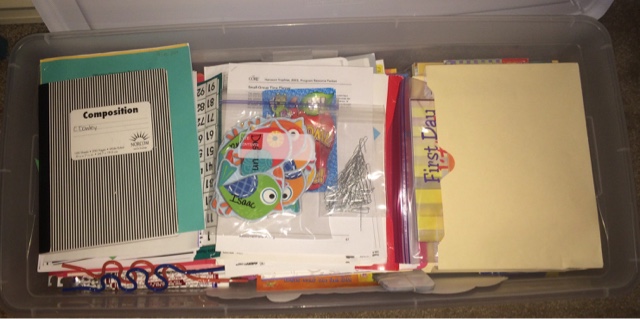
Do you remember my bin?


Well, I said earlier that I'd show you what I keep in there.  Here goes...

The stuff in the August bin is mostly the stuff that goes up on the walls before school begins and the stuff that gets used within the first three days of school. The rest of my "start the school year" stuff is in the September bin. 


There are some notes from professional developments that I wanted to remember.  The pieces to the tree that my students use to check in when they come into the classroom each morning... In looking at those birds, I am reminded that I need to pick up some acetone next time I go to Lowe's.  A folder containing the extra copies from all of the "First Day" work... Random folders containing random things - file folder games that I never made, reading challenge prize certificates that I need to make copies of before school begins, straws for my birthday bouquet, pencils that say "First Graders are #1," postcards to send home before school begins, and random posters that probably won't get put up, word wall word cards, CAFE bulletin board set, VOICES bulletin board set, and GNOMe bulletin board set.  I'll post links to things of interest.  I will also eventually upload my CAFE, VOICES, and GNOMe stuff to my TPT store.  (Disclaimer:  My TPT store isn't nearly as amazing as most others.  I only post things as I create them, and I really only create things when I can't find exactly what I'm looking for... which honestly isn't often.)  Oh, and let's not forget the books!  There are books in this bin!!


This is a set of books that my school purchased for my classroom before I got there.  It's the "Learn to Write" series by Creative Teaching Press.  There are various sets based on grade bands, it looks like.  I have the Grades K-1 set and an incomplete Grades 1-2 set.  You can find the whole series on the Creative Teaching Press website [here].  I will probably go through these books a little more in depth before school begins because obviously I won't use them all on the first day.  Honestly, I probably won't use more than three or four in September even.  They are designed to be a sort of mentor text for writing in various forms.  I'll have to see how they might fit into my writer's workshop.


The First Grade Words of Wisdom pages were written by my students on the last day of school last year.  They came from the Lucky Little Learners TpT store.  When I go back to set up my classroom, I'll make copies and bind a class book for the new Firsties.  Maybe I'll find some serious motivation and bind a copy for each of them to take home.  We'll see. 


These are some titles that I like to read aloud in the first few days of school.  We may or may not get to all of them, but they will all eventually end up in the classroom library in a special "First Days of School" book bin.  (I put them in a specific bin in the library because that helps me to know where they are when it's time to replace them with Fall themed books.)  The kids love to borrow books that I've read to the class previously for Read-to-Self or Read-to-Someone.  The books in this collection include:

Five Little Sharks Swimming in the Sea by Steve Metzger
A cute take on the monkeys jumping on the bed.  Speaking of which...

Five Little Monkeys Jumping on the Bed by Eileen Christelow is also here.

Officer Buckle and Gloria by Peggy Rathman
I use this book to help emphasize the importance of rules and expectations.  In fact, I use a couple of books for this purpose...
No, David by David Shannon
David Goes to School by David Shannon
How Do Dinosaurs Go to School? by Jane Yolen & Mark Teague

Bootsie Barker Bites by Barbara Bottner is also included in this set of books because I start a mini-author study with Officer Buckle and Gloria.  The kids enjoy the book, but they find humor in the fact that Peggy Rathman drew Bootsie to look like herself because she didn't want anyone to think she was calling them mean!  We also read a few of Peggy Rathman's other books, but I have to borrow them from the library.

First Grade Stinks! by Mary Ann Rodman is one of my favorites.  It's all about how Kindergarten is better than First Grade because the teacher is better, the recesses are better, the art is better, the stories are better... There's a nice twist at the end.  It's definitely worth having!

Miss Mingo and the Fire Drill by Jamie Harper is one that I will read in the first couple of days and then put in the October bin.  We have to practice fire and earthquake drills, lock down drills, and stay put drills all in the first day or two of school.  This read-aloud helps introduce the importance of the fire drill.  Pull it out again in October during Fire Safety Week!  (By the way, I just learned that Miss Mingo has a first day of school book.  Maybe worth checking out..?)

And just for fun, I will read There was an Old Lady who Swallowed Some Books! by Lucille Colandro and Charlie Goes to School by Ree Drummond.

We begin reading chapter books right away in my classroom.  I like to start with something fun, something that I can get really animated with because there aren't a whole lot of pictures in chapter books.  I start with Junie B., First Grader (at last!) by Barbara Park.  Chances are good that their Kindgergarten teachers have read them a Junie B. book or two, so I find this to be a good starting place.  We usually take anywhere from five to ten days to read this chapter book.  I'll choose the next one based on what I've learned about my students' interests and attention spans.  (We may need another one with as much opportunity for animation, or we might be able to read Tale of Despereaux at this point.  I've had classes on both ends of that spectrum.)

You can see the books that I read on the first day of school (not included in this post) by [clicking here].

Oh!!! And then there is this gem:


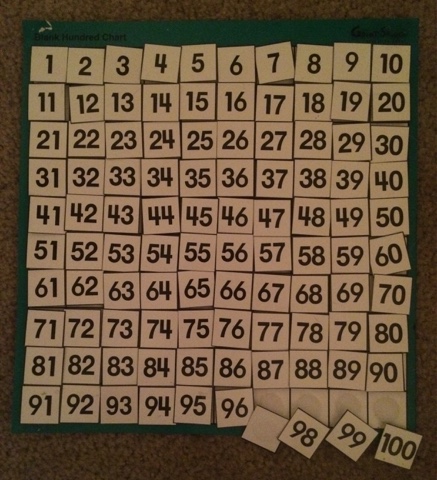
Have you heard of CHAMPS?  There are so many things going around on Pinterest, Google search, TPT, etc.  Well, my school (maybe my district.. I don't know) adopted CHAMPS as a school-wide approach to classroom management.  We're CHAMPSing it up all over the place in my building!  Well, in an effort to make one of the positive behavior strategies work for us, my friend across the hall and I thought long and hard about how to make the 100s board happen.  Well, what do you know?  We are some CHAMPS Champions!! We each took two regular hundreds boards, cut up one, put velcro on both, and now we've got the positive behavior board on lock down!  Well, sort of.  We both need to be better about actually using it.  But we took the first step... We put those suckers up in our classroom! Haha!  (If you're curious, I can explain it later.  It's a strategy from Randy Sprick's book.)

Well, there you have it.  Aside from the birthday crowns and star student crowns, the stickers, and calendar pieces, I think that covers what's inside the box.  Thanks for stopping by!


Get Ready, Get Set... What I Read on the First Day of School

Let's talk about read-alouds on the first day of school!!

I know, I know...

"Why are you talking about the beginning of the school year?  Summer just started!!"

Well, for a lot of the country, summer did just start.  Technically, my summer vacation just started, too.  Except that we got out of school a month ago.  I just managed to finish a good chunk of my homework for the summer semester yesterday.  (I'm working on a graduate certificate in teaching ESL.)  So, until my books come in for my next assignment, I have some down time.  Down time in the teacher brain means... next school year! 

First, the best idea I ever had was under-bed storage bins!  Genius, if I do say so myself.  *toots own horn* 


I have one for every month of school, and I put everything that I need for the month in there.  Read-alouds, craftivities, lesson ideas, templates for random things I've done, holiday-themed stuff, calendar (that would be the month that goes on my bulletin board... doubled as the bin label.  Just full of random good ideas, I tell ya!)...  Everything for the month.  It's a mess in there!  (We can take a look inside a little later.)  EDIT:  "Later" happened... Check out what I have in the bin [here].


I will say that I often outsmart myself with this system.  What did I find upon initially opening the box?  My to-do list from the beginning of last school year, that's what!!  (And yes, I definitely channeled my inner Junie B. there.)


Now I don't need to start over in trying to remember what I do at the beginning of every year.  Brilliant.  Way to go, Carrie!! 

Because I have a separate bin for each month of the school year and I only spend maybe the last three days of August with students in my classroom, the August bin is just the things I need to set up my room and the "first days of school" stuff.  The other things that I use for the rest of the beginning of the year are in the September bin.

Now that that's out of the way, I wanted to talk to you about first day of school read-alouds.  What are your favorites?  I took this bin out so I could share some of mine.  I don't like to force read-alouds in, so I have a few that I make sure to do on Day 1, then the rest are just when we have time in the first few days.


I usually try to read several books on the first day.  This will give my reading and writing mini lessons the kickstart they need later.  (I'll explain what I mean by that some other time.)

You're Finally Here! by Mélanie Watt reminds me of the Pigeon books by Mo Willems.  The character in the story, the bunny, is just so demanding in wanting to know why you didn't show up sooner!  I just bought the book, and I plan to read it to my students during morning meeting right after breakfast on the first day.

The Night Before First Grade by Natasha Wing is a great book to read aloud now and use later for rhyming words.  (Remember when I said I use what I read now for later mini lessons?)  I used to read this book first, but this year I'll read it after we've had some time to settle in and unpack our school supplies.

Later in the morning, I'll read First Day Jitters by Julie Danneberg.  I'm sure that you're all familiar with Sarah Jane Hartwell and her lack of desire to go to her new school on the first day.  I have a couple of writing activities that I usually do with this text, but I might revamp those to use this book as a close reading text.  I'll think more about that later.

The Kissing Hand by Audrey Penn is a favorite among many teachers.  A lot of you do a fun craftivity in which the kids make tiny hearts and glue them to a painted handprint.  Yeah.  I'm jealous of you!  I have so many things to do in this first week of school that I never can get to the handprint.  It's probably okay, though.  I usually have a community building craft that I have the kids do on the first day.

First Grade, Here I Come! by Nancy Carlson is another book that I only recently bought.  I plan to read it during our closing circle.  It describes the main character's, Henry's, first day in First Grade.  I'm hoping to guide the students in having ideas about which they can talk to their parents when they go home.  "How was your day?" "What did you learn?" and "Did you make new friends?" are questions that are prompted in the text.  By addressing this at the end of the day, it would be fresh in the students' minds when they see their parents.

Those are the books that I will make sure to read to my students on the first day of school.  What books do you like to use?  I'm always looking for fun, engaging new titles!


Friday, June 12, 2015

I need homework help!


I have to do an action research project in the fall for my grad program.  That's fine.  I thought I knew what I wanted to research, but the idea sort of got shot out of the water because the teacher didn't really like it.  (She's against anything scripted, which I understand, but I wanted to research the effectiveness of a peer-mediated intervention - which would have been scripted for the kids.  Personally, I thought it was a great idea, but I understand her reservations.)

Anyway.  After a lot of thought and conversation and changing my topic 856 times, I decided to go with researching the effectiveness of a workshop model as an intervention.  She loved that, but I am not in love with the idea.  It's going to be hard to put my whole heart into a topic that I don't really care about, but I also just want to keep my 4.0 GPA.  Arguing with the teacher doesn't get you an A. Haha!

Then, in class last night, she posed a question:  "What do you really want to know? Why do you want to know that?"  That got me thinking... 

I don't really want to know what happens when you use a workshop model as an instructional structure.  I really want to know about interventions that can be done in the classroom, either whole- or small-group, to work on closing the achievement gap *before* it gets to the point that students are being pulled out for tier 3 interventions.  Pulling students for interventions means they are missing time the the classroom.  Whether the time is during core instruction or small-group work or community building activities is irrelevant.  They are missing that time in class!  Maybe it's not an actual intervention that I'm looking for.  Maybe it's just a structure (for example, the workshop model).  I just want my students in class, and I want to know how to keep them there!

So I have to come up with a topic, and from there I need to derive a research question.  This is where I'm stuck.

Feel free to poke holes in this, provide suggestions, offer your insight...

Here's the evolution of my question:

"What happens when interventions are provided in class instead of in a pull-out model to increase academic achievement and decrease required tier 3 support?"

Honestly, I just didn't like how I worded that question.  I don't know if I want to use the word "interventions" because I don't know that I would strictly focus on providing interventions.  A classmate suggested differentiation rather than interventions, but I don't know about that because research already supports differentiation.  I want to get more at the idea of keeping my kids in my classroom.  

I guess "differentiation" is exactly what I would need to do then... ... ...

But I kept thinking...

The question became:

"What happens to student identify and achievement when tier 1 instruction and tier 2 interventions are structured and differentiated with the intent of preventing the need for pull-out tier 3 interventions?"

I thought that was a little wordy, but it sort of says what I want... I think...?

That became:

"What happens to student achievement when instruction is structured and differentiated with the intent to prevent the need for pull-out interventions?"

I just don't know about that one because I got back to the idea that we, as teachers, should be doing that anyway... So why research it?

Then I circled back around to the workshop model.  My question changed to:

"What happens when a workshop model is used in core content areas in a primary classroom as a means of differentiation and intervention?"

But that takes out the other component that I wanted to research:  the peer tutoring as a whole-class intervention.

The more I think about it, the more frustrated I get.  I'm hoping that, by putting it out there in cyberspace, someone will be able to help me find the words to really get to the root of my curiosity.

Your opinions? 
Please and thank you! 


Thursday, October 2, 2014

BookSource Classroom Organizer

Have you been looking for a way to organize (and keep up with) all of your classroom library books?

Have you been losing sleep over finding a kid-friendly way to let your students check out library books? (Goodness, I hope not!)

Have you wished you could quickly and easily teach your students how to check out their own books?

Well, look no more!  This app is stinkin' amazing!  (Actually, I don't know about that check-out-their-own-books thing... I haven't tried to teach my first graders this yet.  We shall see... *fingers crossed*)

I found this app/website combo a few years ago. I intended to use it with my fourth graders, but I was so overwhelmed by my classroom library that I decided against using it. I'm a little ashamed of that decision now. 

BookSource Classroom Organizer is a website with an app component. (You must have an account with the website before you can use the app.) No worries, though. It's completely free!

When you go to the website and set up your account, you can download the app.  There's an app for both iPhone and Android.  You will use the same account login information that you used on the website.


Your classroom library book list will sync between the app and website instantaneously as you scan books with your phone or tablet and/or upload the books online.


The only downside that I found to setting up my library within the system was that it is fairly time-consuming.  It took me two hours to scan and upload 208 books.

Something to consider, though...

If I remember correctly, the system is designed to be growing and updated often.  If you scan a barcode for a book that other teachers have scanned, the information should come up and you only need to click "Add to Library."  If the book has not been previously uploaded, you will need to add the title at least (you may add the rest of the identifying information if you would like) before adding the title to your online library.

I have not played with all of the features of this website yet, but it looks like students and parents can view the titles that you have in the classroom using the student page.  How convenient!  It also seems that the students can see the availability of the books.  The more I look into this system, the more I like it!  I hope you find it just as useful!  If you have a website/app that you like for organizing the classroom library, I'd love to hear about it!